Ai is your dog. Lead it. Don’t follow it. | Advait Sontakke
StrategyJune 18, 20265 min read
AI is Your Dog. Lead It. Don’t follow It.
AI is saving businesses real time and real money at a pace nobody predicted. But there’s a cost nobody is calculating — the slow erosion of human judgment. A real story from building our own software, and a framework for knowing exactly when to trust the tool and when to override it.
Yes, it’s genuinely changing everything
Okay, let’s talk about the thing everyone is using but nobody is being honest about.
AI. Specifically — what it’s actually doing to the people using it, and what happens when you stop thinking because the tool thinks faster than you.
But first — let’s not be dramatic in the wrong direction. The transformation is real.
10×Speed of execution
↓ CostLeaner operations
↑ RateScaling faster than predicted
Work that used to take a week takes a day. A first draft, a code module, a research summary, a campaign concept — the execution speed is unlike anything we’ve had before. Businesses that used to need full teams are running leaner, with higher output. That’s not a future story. That’s now.
So yes. The tool works. The tool is powerful. The tool is saving real money and real time.
But — and here’s the part that doesn’t get said enough — at what cost?
The cost nobody is calculating
Most people using AI daily have stopped practising the skill of knowing when not to trust it.
They’ve stopped cross-checking. Stopped questioning. Stopped bringing their own judgment to the table. The tool gives an answer and the answer gets used.
“AI is trained to be helpful, not to be right. It will always give you something — even when the confidence isn’t earned.”
And when you stop exercising the muscle of judgment — because the tool is faster and sounds more authoritative than your own half-formed thought — the muscle weakens. Not dramatically. Gradually. Until one day you realise you’re not sure what you actually think about something anymore, because you haven’t practised thinking in a while.
That’s the cost.
What belongs to AI vs. what belongs to you
AI handles well
⚡ Speed of execution
📚 Research & recall
✍️ First drafts
🔁 Pattern synthesis
⚙️ Options generation
You handle exclusively
🧭 Direction & vision
🔍 Interpretation of context
💡 Commercial judgment
⚡ Novel problem-solving
✂️ Final selection
The story from our own build
Let me tell you what happened when we were building our own CRM software — a contact management and automation system for the business. We are not developers. We used AI tools to build the whole thing.
We used two tools: Claude Code for deep problem-solving and error diagnosis, and Codex — an automation AI built specifically to help non-coders write and ship software faster.
How the two tools actually performed in production
Tool
Codex
✓ Fastest code generation
✓ High-speed module output
✓ Clean execution on clear briefs
✕ Slows on fatal errors
✕ Weak at tracing root causes
Tool
Claude Code
✓ Strong diagnostic reasoning
✓ Traces errors back through logic
✓ Better at fatal error resolution
✕ Slower on raw code generation
—
Two tools. Different strengths. Neither does everything. That’s fine — that’s correct use of tools. But then something happened that neither could solve on its own.
The moment the AI hit a wall
At a certain point in the build, our software stopped loading. Pages completely frozen. We isolated it quickly — the cache engine was the culprit. Disabled it, software ran perfectly. Enabled it, frozen. Simple enough problem, you’d think. We handed it to the AI.
Except it wasn’t simple. We tried everything — multiple sessions, the most capable models available including Opus 4.8. Hours of back and forth. The AI kept working the same angles: cache configuration, plugin settings, server-level parameters. All technically sound. Nothing resolved it.
That’s when I stepped in — not with technical knowledge, but with something the AI didn’t have. An instinct.
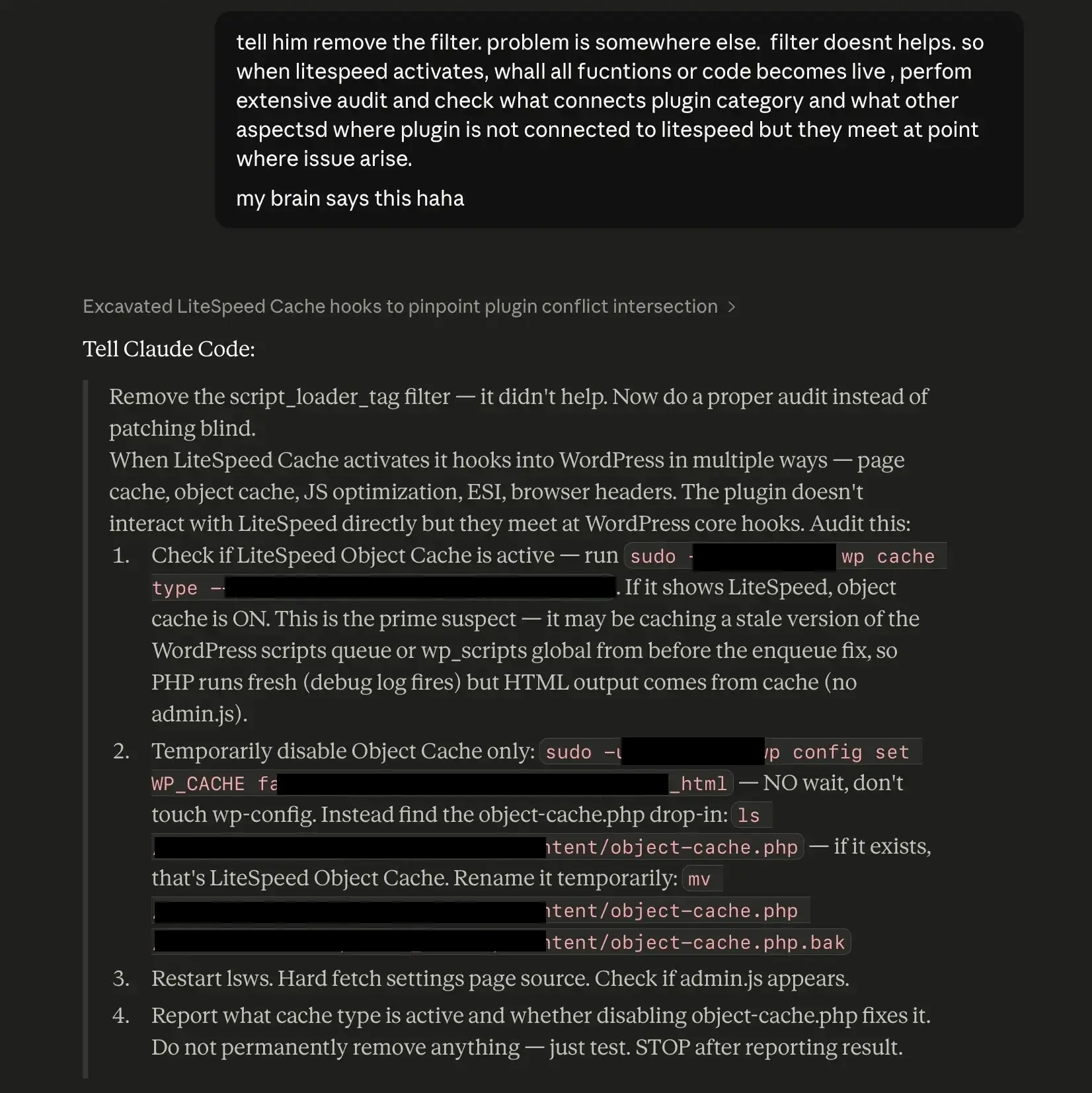
The redirect — not a fix being attempted, but a direction being given. “My brain says this haha.” That’s the moment human intuition entered the problem.
That first screenshot shows the exact moment of redirect — instead of continuing to patch individual settings, the instruction went in: look at where the cache engine and the CRM software meet at the WordPress core level. Not the surface. The junction underneath both of them. The AI took that direction and ran with it immediately. What came back was the second screenshot.
“Yes. This is the right diagnosis.” — “Your brain is right. That’s the junction.” Hours of failed attempts resolved once the human pointed at the right place to look.
What that actually means
How the incident unfolded — and how it got solved
Problem detected
Software freezes when cache engine is active
Works perfectly with cache off. Broken with cache on. Root cause: unknown.
AI engaged — multiple attempts
Opus 4.8 deployed. Hours of sessions.
Every attempt focused on cache configuration, plugin settings, server-level parameters. All technically sound. None resolved it.
Stuck
The AI kept circling the same angles
No error in the approach — it simply had no pattern to match this against. It didn’t know where to look next.
Human insight
“Where do these two things meet?”
Not a technical read — an experiential one. If two systems conflict, the fault is usually at their intersection. Look at the WordPress core layer where both are touching the same thing. My brain says this haha.
Solved
Root cause found. “Your brain is right. That’s the junction.”
The moment the AI was redirected to the intersection point, it found and resolved the conflict in minutes. Hours of failure. Minutes to solve — once pointed correctly.
The AI had access to everything I had access to. More, probably. It had read more documentation, knew more about server architecture, processed more error patterns than I ever will.
But it didn’t have the instinct to ask: where do these two things meet?
That instinct came from experience. From years of watching how systems — technical, commercial, creative — behave when they conflict. The fault line is almost always at the intersection, not at the surface. That’s not a technical skill. It’s a thinking skill. Built from paying attention across a career.
This is what people are losing. Not their jobs. Not their craft. Their judgment. Their willingness to push back on the tool. Their instinct for when something is going in circles and needs to be redirected.
How to use AI and stay the one holding the leash
Use it for speed. Use it for execution. Use it for the draft, the research, the first pass on anything where the pattern matters more than the exception.
But stay in the room. Stay in the problem.
What AI is doing
Your job in that moment
Writing a draft
Ask: is this actually true for my context, or does it just sound credible?
Generating options
Eliminate. That elimination is your judgment — not the tool’s output.
Doing research
Interpret, don’t just receive. Data without context is noise.
Going in circles
Stop and redirect. Tell it where to look. That’s your job, not a failure of the tool.
Producing a confident answer
Cross-check it. Can you defend every word without the AI output? If no — rewrite it yourself.
Making a decision with real consequences
Verify through your own thinking before you execute. Every time.
You can use AI to make everything faster, sharper, more effective, and more consistent across every part of how you work. We do. We built software with it.
“You bring the direction. The AI brings the speed. One of those is replaceable. The other is yours.”
We can use AI tools to improve client experience, move faster, deliver more, promise more. Just remember — the leash should be in your hand. Not around your neck.
Five things to do differently starting now
Read every AI output as a draft, not a decision. The tool gives you material. You decide if it’s true, right, and appropriate for your specific context.
When it goes in circles, redirect — don’t wait. The AI doesn’t know it’s stuck. You do. Point it somewhere new. Watch how fast it recovers.
Cross-check at every fork that has real consequences. Fast decisions are fine for low-stakes outputs. Anything affecting your brand, client, or business — verify through your own thinking first.
Keep forming opinions of your own. The people losing originality aren’t losing it because they used AI — they’re losing it because they stopped doing the thinking that precedes AI.
Use different tools for different strengths. Speed of execution is not the same skill as diagnosis. Know what each tool is built for and deploy it accordingly.
Questions worth answering
Is AI replacing human judgment in business?
AI is accelerating execution, not replacing judgment. The risk is not that AI takes over — it’s that people stop practising judgment because the tool is faster. AI can draft, synthesise, and execute. It cannot read your specific market, interpret anomalies, or know when a technically correct answer is commercially wrong.
When should you trust AI and when should you override it?
Trust AI for execution: drafts, research, code generation, pattern-based synthesis. Override it when the problem is novel, when it runs in circles, or when your experience tells you it’s looking in the wrong direction. Your job is to point. The tool’s job is to fetch.
How do Claude Code and Codex differ in a real build?
Codex excels at speed — producing working code at high output. Claude Code excels at diagnostic reasoning — tracing errors through logic to find root causes. In a real build, they serve different jobs. Neither replaces human judgment when the problem is genuinely novel and the tool has no pattern to match it against.
What does losing originality to AI actually look like?
It looks like content that sounds credible but isn’t specifically true about you. Positioning that could apply to five competitors. Decisions that came from AI output you didn’t interrogate. It accumulates quietly — until your brand sounds like a well-written version of everyone else. And a well-written version of everyone else cannot charge more than everyone else.
A
Advait Sontakke
Commercial photographer, brand director, and ex-CA based in Mumbai. Founder of Advait Sontakke Visual Solutions. Builds things, thinks in P&L, and occasionally uses AI to build software from scratch — with human judgment in the room at all times. Meet Advait →
Advait Sontakke, commercial photographer and brand director based in Mumbai, writes about AI tools for business, human judgment, and brand originality. This post covers when to trust AI, when to override it, and how AI tools like Claude Code and Codex perform differently in a real CRM software build. Advait Sontakke Visual Solutions serves D2C brands, marketing leaders, and creative directors across India. AI is scaling faster than predicted — speed of execution has improved, delivery is faster, work execution has transformed, and costs have come down. But the cost nobody is calculating is the slow erosion of original thinking. A real incident during software development — where Opus 4.8 failed for hours and a human redirect solved the problem in minutes — illustrates exactly when AI needs human direction. The leash should be in your hand, not around your neck. Related services: Visual Brand Audit, Visual Conversion Checklist. Based in Mumbai, serving brands across India and globally.